
Industry · March 2026
What is Gaussian Splatting, and why does it matter for property?
Richard Gould · 8 min read · Updated March 2026

A heritage residence captured for archival splat work, February 2026.
Gaussian splatting is the first spatial capture technology that feels photoreal on a phone. That’s the headline. The rest of this piece is about what that actually changes for the people selling buildings — agents, developers, and anyone else whose job depends on how a space presents on a screen.
I’ve been shooting Matterport tours since 2019. They’re excellent — they’re still the right tool for most residential work. But for the first time in seven years, something has come along that makes me want to replace the primary tool on a certain kind of job. That something is Gaussian splatting, and if you work in property media, it’s worth ten minutes of your attention.
What is it, roughly?
A Gaussian splat is a 3D scene rendered not from polygons and textures — the way games have done it for thirty years — but from millions of tiny, semi-transparent “splats” of colour and depth. The result looks like a photograph you can walk around inside. Soft edges stay soft. Glass looks like glass. Reflections reflect.
The technical lineage goes: photogrammetry → NeRFs → 3D Gaussian splatting. The latest generation trains in minutes on a modern GPU and plays back in a browser on a mid-range phone.
A Matterport is an assembly of still photographs you hop between. A splat is the room.
Where it beats Matterport
Three places, specifically:
01
Off-plan marketing. You can stage a completed apartment and sell the development before the concrete’s dry.
02
Architectural portfolios. A splat preserves the feeling of a space in a way a Matterport can’t. Material, light, volume.
03
Heritage and museum work. Photoreal archival of rooms, objects and interiors that can be revisited in a hundred years without a camera ever going back.
Where Matterport still wins
Standard residential listings. Matterport has a certified pipeline, a published URL, dollhouse view, and a floor plan export agents know how to drop into Rightmove. For a 4-bed semi on a 48-hour turnaround, Matterport is still the correct tool. Gaussian splatting is for when the space or the brief warrants more.
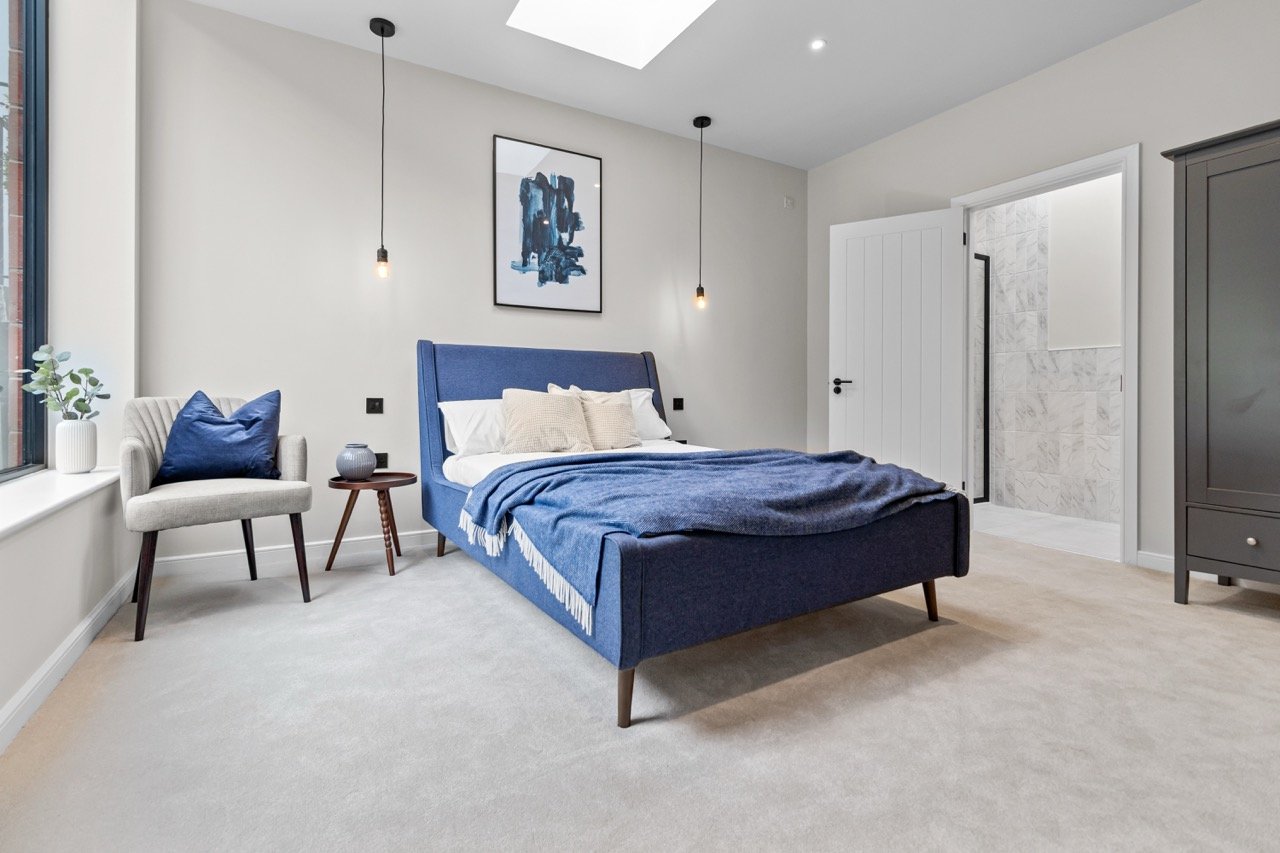
Material, light, volume — the texture splats preserve that polygons throw away.
What I charge, and why it’s bespoke
Right now, Gaussian splatting is quoted per job rather than on a rate card. Three reasons: capture time varies a lot by space; training cost varies by scene complexity; and hosting is non-trivial at splat file sizes. My residential splats typically land somewhere between a premium Matterport and a full architectural photography commission. For development work, the number scales with size.
If you’ve got a specific space in mind, send me the postcode, the sq.ft, and what you’d want to do with the result. I’ll reply with a fixed quote within a few hours.
Keep reading
Industry
Matterport vs Gaussian splatting — which is right for your space?
7 min read
Developers
Why off-plan developments need Gaussian splatting tours
9 min read
Agents
How better photography reduces time on market
5 min read